Asymptotes
A vertical asymptote describes unbounded values as the input approaches a number from at least one side. A horizontal asymptote describes outputs approaching a fixed height as the input goes far in a stated direction. A graph can cross a horizontal or slant asymptote at a finite input. Begin with y=1/x: zero cannot be used as an input, values become large near zero, and values approach zero far away. In y=2/(x−3)+1, the same picture moves right 3 and up 1, suggesting vertical asymptote x=3 and horizontal asymptote y=1. An asymptote describes approach, rather than a universal rule that a graph can never cross a line. Precalculus develops holes, polynomial degree comparisons and slant asymptotes.
Before you begin
Evaluate 1/x at nonzero inputs and recognize horizontal and vertical shifts of a graph.
What you will learn
- Read a vertical barrier from a shifted reciprocal graph
- Use a table to see horizontal leveling
- Keep denominator exclusions
Understand the idea
A vertical asymptote describes unbounded values as the input approaches a number from at least one side. A horizontal asymptote describes outputs approaching a fixed height as the input goes far in a stated direction. A graph can cross a horizontal or slant asymptote at a finite input. Begin with y=1/x: zero cannot be used as an input, values become large near zero, and values approach zero far away. In y=2/(x−3)+1, the same picture moves right 3 and up 1, suggesting vertical asymptote x=3 and horizontal asymptote y=1. An asymptote describes approach, rather than a universal rule that a graph can never cross a line. Precalculus develops holes, polynomial degree comparisons and slant asymptotes.
Worked example 1
For f(x)=2+3/(x−1), use the graph and formula to choose the vertical and horizontal asymptotes. A. x=−1,y=2. B. x=1,y=3. C. x=1,y=2. D. x=0,y=1.
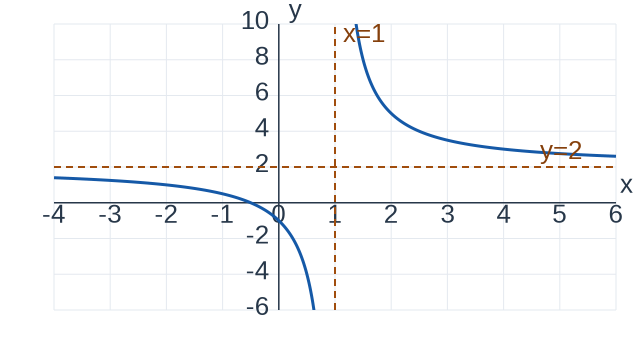
- C is correct. As x approaches 1, the nonzero numerator divided by x−1 becomes unbounded, so x=1 is a vertical asymptote.
- For large positive or negative x, 3/(x−1) approaches zero, so y=2 is the horizontal asymptote. The input x=1 is excluded.
Worked example 2
Sketch the shifts in g(x)=2/(x−3)+1 and identify its asymptotes.
- The denominator is zero at x=3, giving vertical asymptote x=3.
- Far from x=3, the fractional term tends to 0, so the horizontal asymptote is y=1.
Diagnose an error
Does g(x)=1/(x−3) have vertical asymptote x=−3?
Compare your reasoning
Does g(x)=1/(x−3) have vertical asymptote x=−3?
- Set the denominator equal to zero: x−3=0.
- The excluded input and vertical asymptote are at x=3.
Independent practice
Submit your answer in the interactive lesson to unlock the worked solution. Type your reasoning or build it with clickable tiles.
Practice 1
Find the vertical asymptote of 1/(x+2).
Solution locked until submission.
Practice 2
Find the horizontal asymptote of 3+1/x.
Solution locked until submission.
Practice 3
Is f(100)=0 for f(x)=1/x, or only close to 0?
Solution locked until submission.
Practice 4
A model gives average cost C(n)=5+60/n dollars for n positive items. Interpret 5.
Solution locked until submission.
Connect and reflect
Use shifted reciprocal pictures and numerical tables first; later courses develop cancellation and polynomial end behavior.
Original Cookmath explanations and exercises. Scope reference: IM v.360 Algebra 2 — scope reference. Cookmath units are smaller study groups, not publisher chapter counts.
