Graphs
Degree and leading coefficient control the far ends of a polynomial, while a zero's multiplicity controls whether the graph crosses or touches the axis.
Before you begin
Identify polynomial zeros and determine the sign of a product.
What you will learn
- Predict end behavior from degree and leading coefficient
- Use multiplicity to predict crossing or touching
- Compute intercepts
- Check signs between zeros
Understand the idea
Far from the origin, the leading term controls polynomial end behavior. Near a real zero, an odd multiplicity changes the sign and an even multiplicity preserves it. These facts locate crossings and touches, but do not determine every turning point. Combine them with intercepts and sample values to make a justified sketch.
Worked example 1
Read the graph and choose the correct statement. A. It crosses at −1 and touches at 2. B. It touches at −1 and crosses at 2. C. There is no zero at 2. D. Both ends point down.
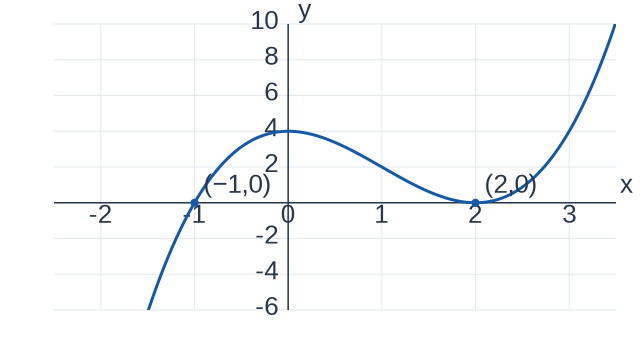
- A is correct: the curve changes side at x=−1 and returns to the same side at x=2.
- These behaviours match the simple factor x+1 and the repeated factor (x−2)² in (x+1)(x−2)². The left end falls and the right end rises.
Worked example 2
Sketch key features of y=(x+1)²(x−2).
- Degree 3 and positive leading coefficient mean left end down, right end up.
- The graph touches at x=−1 (multiplicity 2) and crosses at x=2 (multiplicity 1).
- The y-intercept is −2; except at −1 the sign is negative for x<2 and positive for x>2.
Worked example 3
Analyze y=−(x−1)(x+2)(x−4).
- The leading term is −x³, so left end rises and right end falls.
- All three simple zeros −2,1,4 are crossings.
- At x=0, y=−8; signs alternate across the simple roots.
Diagnose an error
A student draws every polynomial zero as a crossing. Give a counterexample.
Compare your reasoning
A student draws every polynomial zero as a crossing. Give a counterexample.
- For y=(x−1)², the zero 1 has multiplicity 2.
- Values on either side are positive, so the graph touches the axis and turns back rather than crossing.
Independent practice
Submit your answer in the interactive lesson to unlock the worked solution. Type your reasoning or build it with clickable tiles.
Practice 1
Use the same graph. On which interval is the function negative? A. x<−1. B. −1<x<2. C. x>2. D. All real numbers.
Solution locked until submission.
Practice 2
Describe the ends of y=−2x⁴+3x−1.
Solution locked until submission.
Practice 3
Does y=(x−3)⁴ cross or touch the x-axis at 3?
Solution locked until submission.
Practice 4
Can end behavior alone determine the number of real zeros?
Solution locked until submission.
Practice 5
For a cost difference D(t)=(t−2)(t−5), determine when the first cost exceeds the second for t≥0.
Solution locked until submission.
Connect and reflect
A reliable sketch joins algebraic evidence: end behavior, zeros, multiplicities, intercepts and interval signs.
Original Cookmath explanations and exercises. Scope reference: IM v.360 Algebra 2 — scope reference. Cookmath units are smaller study groups, not publisher chapter counts.
